Property Boundary Fencing in Ohio
A boundary fence answers a question your yard can’t answer on its own: where does your property actually end? Done well, it keeps kids and pets inside, keeps neighbors’ projects and wandering mowers out, and gives everyone a visible line to respect. Done badly, it becomes the thing two households argue about for years.
Scheiderer Fence installs property boundary fencing for Ohio homeowners, from tight suburban lots to larger parcels on the edge of town. We build to the line your survey shows, set posts to survive freeze-thaw winters, and make sure the fence you pay for ends up on the right side of the property line. Call 937-243-9991 for a free on-site estimate.
What a Boundary Fence Is Really For
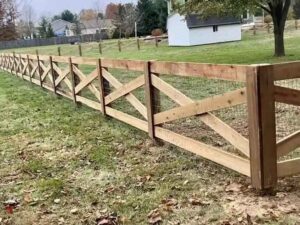 A privacy fence is judged by how well it blocks a view. A decorative fence is judged by how it looks. A boundary fence is judged by two things: accuracy and staying power.
If a privacy fence ends up a foot off from where you pictured it, nobody notices. If a boundary fence is a foot off, it can lead to a disagreement with a neighbour, a removal bill, or problems when you sell. That is why our custom residential fence solutions start with measurements, not materials.
Start With Your Survey
A fence does not create your property line, and it does not prove where the line is. Your deed and a survey do. A licensed surveyor marks your lot corners with metal pins, and we work from those pins.
- Have a survey from your closing? Bring it to the estimate. Older surveys are useful, but pins get buried, pulled out, or covered by landscaping over the years.
- Can’t find the pins? Have a surveyor re-stake the lot before posts go in. We build to the line you give us. We don’t set the legal boundary ourselves, and we won’t guess at it.
- Old fence already there? Don’t assume it sits on the line. Plenty of existing fences were built a little inside, or a little outside, of where they should be.
Where the Fence Goes in Relation to the Line
There are three layouts we see most often on Ohio residential lots:
- Just inside the line: This is the most common choice. Footings and the fence itself stay entirely on your lot, so the fence is clearly yours to build, repair, and replace.
- On the line: A shared fence can make sense when both neighbors want one, but it should be backed by a written agreement about who owns it and who maintains it.
- Set back farther: Some cities require a setback, and some homeowners prefer a gap that leaves room to reach the fence from both sides.
The legal side of this, including setbacks, neighbor notice, and what happens when a fence sits over the line, is covered in our guide to Ohio fence property line laws. On this page, we’re focused on how the fence actually gets built.
Best Fence Types for a Property Line
The right material depends on what the line has to do. Marking a quiet side yard is different from separating you from a busy road.
- A solid choice when you also want some privacy along the line. Cedar and pressure-treated pine both hold up in Ohio when posts are set properly. Many suburbs expect the finished side to face the neighbor.
- Low maintenance, and easy to match to a neighbor’s existing fence color. Check your community’s rules first, since some restrict vinyl.
- Chain link: Cost-effective over long runs and practical for pets. It is commonly allowed in side and rear yards but often restricted in front yards.
- Defines the line without building a wall, and keeps views open. If you want to see how this style is built, our ornamental iron fencing page shows the look.
- Split rail or wire: Better suited to larger lots and rural-edge properties. See our agricultural fencing services for those builds.
Not sure which direction fits? Our fence materials page compares them side by side.
How We Install a Boundary Fence
- Review the survey and walk the line with you: We confirm where the pins are and where you want the fence relative to them.
- Locate utilities: Underground lines are marked through 811 before any digging starts.
- Lay out the fence: We run a string line between points so the fence stays straight over the full length, then confirm the layout with you before posts go in.
- Set posts in concrete: Post depth is planned around Ohio’s frost line so the fence doesn’t heave and lean after the first hard winter.
- Hang panels, pickets, or fabric: Spacing and height stay consistent, even where the ground changes.
- Fit the gates: Gates are squared and hung on heavy-duty hardware so they don’t sag.
- Final walkthrough: We walk the finished line with you and confirm everything matches the plan.
Site Conditions That Change the Plan
Property lines don’t follow the easy parts of a yard. These are the situations that most often change how a boundary fence is built:
- On uneven ground we use a stepped or raked layout so the fence follows the grade without leaving gaps.
- Trees and roots on the line: Large roots can force a post to shift, and we’ll talk through the options before digging.
- Utility easements: Some lots have strips where a fence may be restricted or may need to be removable.
- Corner lots: Many cities require clear sight lines near intersections, which can limit fence height close to the corner. Our Ohio fence permit guide explains how this plays out in different cities.
- Shared driveways and access points: A boundary fence has to leave room for the way you actually use the property.
Gates Along Your Boundary
A boundary fence that you can’t get through is a problem the first time you need to move a mower, a trailer, or a load of mulch. We plan gate locations while we lay out the line, so access is built in rather than cut in later. If you’re planning a wider opening or an automatic gate, take a look at our gate installation services.
What Affects the Price of a Boundary Fence
Boundary fences are priced by the foot, but the final number depends on the job. The biggest factors are:
- Total length of the line
- Material and height
- Slope, rock, roots, or other digging challenges
- Removal and disposal of an old fence
- Number and size of gates
- Permit and clearing needs
For a closer look at how those pieces add up, read our fence installation cost guide for Ohio. Monthly payment options are also available if you’d like to spread the cost out.
Before You Call: A Quick Checklist
- Find your survey or plat map, and locate the corner pins if you can.
- Talk with your neighbor before work begins. It costs nothing and prevents most disputes.
- Check whether your neighborhood has an HOA. If it does, see our page on HOA-compliant residential fencing before you pick a style.
- Decide how much privacy, visibility, and maintenance you want along the line.
Boundary Fencing Across Central Ohio
We install residential boundary fences in Delaware, Dublin, Marysville, Richwood, and surrounding communities. Local rules vary a lot from one city to the next, so we check your municipality’s requirements as part of the estimate. You can see the areas we cover on our locations page.
Property Boundary Fencing FAQs
Do I need a survey before installing a boundary fence?
If your property pins are missing or you aren’t sure where the line runs, yes. A survey is the only reliable way to know where the line is, and it is far cheaper than moving a fence after it’s built.
Can you find my property line for me?
We build to the line shown on your survey and pins. Legally establishing the boundary is the job of a licensed surveyor.
Should the fence go directly on the property line?
Most homeowners build just inside it, so the fence is entirely on their own land. A fence on the line is usually a shared project and should have a written agreement behind it.
What if my neighbor doesn’t agree with the fence location?
An up-to-date survey is the best starting point for that conversation. If the disagreement continues, it’s worth settling before any posts are set, not after.
How long does a boundary fence take to install?
Most residential boundary projects take a few days once materials, permits, and layout are in place. Length, terrain, and weather all affect the schedule.
Can you remove my old fence and replace it?
Yes. Removal can be included in the estimate, and we’ll point out any spots where the old fence line doesn’t match your survey.
Get a Free Boundary Fence Estimate
If you’re ready to put a fence on your line, or just want to know what that would take, we’ll come out, walk the property with you, and give you straight answers with no pressure. Call 937-243-9991 or request your free estimate.