Most single-vehicle driveway gates are 10 to 12 feet wide. If you have a wider entrance, two vehicles, or a trailer, gates go up to about 14 to 20 feet. The right size for you depends on the vehicles you drive, how your driveway meets the gate, and how the gate opens.
- Single swing gate: about 10 to 14 feet wide
- Double swing gate: about 12 to 20 feet wide in total
- Sliding gate: about 12 to 20 feet wide
- Gate height: about 3 to 8 feet, usually matched to your fence
This guide shows how to pick the right width, how to measure your driveway, and which sizing details people often miss.
What Is the Standard Driveway Gate Width?
For a single car or SUV, 10 to 12 feet is the most common choice. It gives enough room to drive through without scraping the gate or the posts.
Gates narrower than 10 feet rarely work well. Many SUVs and pickups are around 7 to 8 feet wide once you count the mirrors, so there is very little space left to steer.
Here is a detail most people don’t know. A “12-foot gate” usually means the size of the opening it fills, not the exact width of the gate itself. The gate panel is a bit smaller to leave room for hinges, latches, and movement. A professional installer building custom gates fitted to driveways measures your real opening first and sizes the gate around it.
How to Pick the Right Gate Width
Start with the widest vehicle that will use the entrance, not just your everyday car. Measure it with the mirrors out. Then add a margin on each side. A foot or more per side is a sensible rule of thumb, because nobody drives through a gate perfectly straight.
Think about everything that will come through the opening:
- Delivery trucks and moving vans
- Trailers, boats, and campers
- Tractors, hay wagons, and livestock trailers on farm properties
- Emergency vehicles
If your driveway curves as it reaches the gate, choose a wider gate. A 10-foot opening that works on a straight approach can feel tight on a curve.
Also plan for later. A bigger vehicle or a trailer added in a few years is much easier to handle if the gate has some extra width from the start.
Swing Gate or Sliding Gate: Which Needs More Space?
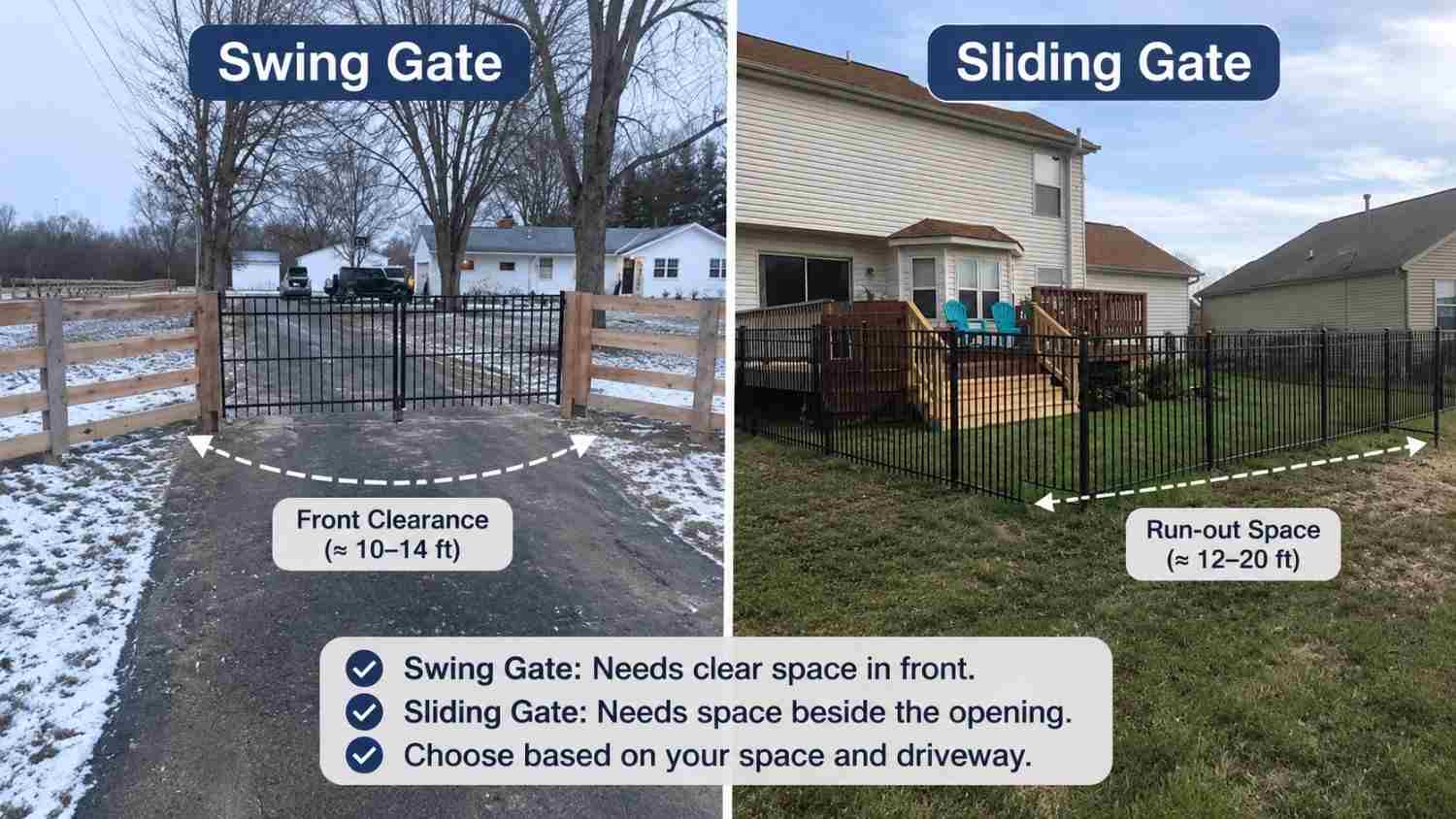
The gate type changes how much room you need around the opening.
A swing gate needs clear ground in front of it so the gate can open in an arc. If your driveway slopes up toward the gate, the gate can scrape the ground. In that case, the gate may need to open the other way or be built with an angled bottom.
A sliding gate needs open fence line beside the opening. As a general guide, plan for a run-out space about equal to the opening width, plus a few extra feet. Slide gates work well on sloped driveways or where there is little room in front of the gate.
Wider gates also need more material, and automated ones need stronger operators. Budgeting for an automated entry is much easier once you have settled on a width.
Ohio’s freeze-and-thaw cycles can also shift gate posts over time, which affects how smoothly a gate opens. Knowing how Ohio weather wears fences helps you leave sensible room for movement.
How Tall Should a Driveway Gate Be?
Most driveway gates are between 3 and 8 feet tall. Many are built to match the fence they connect to, so the entrance looks consistent from the street.
A taller gate gives more privacy and security. A shorter, more open gate feels lighter and lets you see the driveway from the road. Height can be limited by local rules, so check the local height limits for gates before you choose a design.
How to Measure Your Driveway for a Gate
Good measurements prevent most sizing problems. Follow these steps:
- Mark where the gate posts will go. Remember that posts take up part of the opening.
- Measure the clear space between the inside faces of the posts, not the edges of the driveway.
- Measure at the narrowest point and again at ground level, since walls or plants can make the opening uneven.
- Check how much the driveway slopes toward the gate.
- Confirm there is enough open space for the swing arc or the slide run-out.
Material matters too. A heavy gate across a wide opening needs strong posts and hardware, and materials that suit Midwest weather hold up better when the gate is large.
Common Gate Sizing Mistakes
These mistakes come up again and again:
- Choosing the narrowest gate that technically fits a car
- Measuring the driveway instead of the space between the posts
- Ignoring the slope in front of a swing gate
- Forgetting the run-out space a sliding gate needs
- Measuring only the daily car and not the truck or trailer that comes later
Before You Build Your Gate
If your gate crosses a long private drive or serves more than a single home, fire code rules may apply. Ohio’s fire code covers fire apparatus access roads and requires approval for security gates across them. Read Ohio’s fire access road rules and confirm the required opening width with your local fire department.
Next, talk to installers. It helps to know what to ask your installer about measuring, post depth, and hardware. A good installer measures your opening on site instead of relying on a standard size.
Small oversights during the build can turn into repairs later. Reading about installation mistakes worth avoiding early helps you spot them before they cost you time or money.
FAQs
How wide should a driveway gate be?
Most single-vehicle driveway gates are 10 to 12 feet wide. For two vehicles, trucks, or trailers, 14 to 20 feet is more common.
What is the minimum width for a driveway gate?
The minimum is whatever fits your widest vehicle with a comfortable margin on each side. In practice, gates narrower than 10 feet are rarely practical for cars and SUVs
What size gate for driveway do I need?
Measure the clear space between your posts, then choose a width that fits your widest vehicle with extra room. Allow for the swing arc or the slide run-out, and check for slope.
Ready to size a gate for your driveway? Plan your gate with us, and we’ll measure your opening and recommend a width that fits.