
Before you dig a single post hole, there’s something more important than picking the right wood or choosing a colour: understanding Ohio fence laws. Every year, homeowners across Ohio install fences without checking local rules, and plenty of them end up tearing those fences down at their own expense. That’s a costly mistake that’s completely avoidable.
This guide breaks down everything you need to know: where you can legally build, how tall your fence can be, who pays when a fence sits on a shared property line, and what to do when a neighbour dispute turns into something more serious.
What Are Ohio’s Fence Laws? (ORC Chapter 971 Explained)
Ohio fence regulations operate on two levels, and most homeowners don’t realize this until they’re already in trouble.
State law: specifically Ohio Revised Code (ORC) Chapter 971, governs partition fences between adjoining rural and agricultural properties. This law defines a partition fence as any fence placed on or near the division line between two adjacent properties. It covers who builds it, who maintains it, and how costs are split. Importantly, the 2008 revision to ORC Chapter 971 also recognizes fences that have historically been treated as property line dividers, even if a later survey shows the fence wasn’t technically on the exact property line.
Local ordinances: city codes, zoning rules, and HOA covenants govern residential fencing in municipalities and platted subdivisions. If you live in Columbus, Cincinnati, Cleveland, Dayton, or any Ohio city or suburb, your local zoning code is the primary set of rules that matters to you. State law largely steps aside in these areas.
Understanding which set of rules applies to your specific property is the first and most important step.
Ohio Fence Height Laws: How Tall Can Your Fence Be?
Ohio fence height rules vary by municipality, but common residential standards follow a consistent pattern across most cities:
- Front yard fences: Generally limited to 4 feet in height. Some cities, including Columbus, restrict front yard and street-visible areas even further, sometimes as low as 30 inches in vision clearance zones near driveways and intersections.
- Backyard and side yard fences: Typically allowed up to 6 feet in height without a building permit.
- Fences over 6 feet: Considered structures in many Ohio municipalities, requiring a building permit. These fences often cannot be placed in required setback areas or side yards.
Always verify height restrictions with your local zoning office before purchasing materials. Columbus residents can contact Building and Zoning Services at 111 North Front Street. Rules in your city may differ from what’s listed here.
How Close to the Property Line Can You Build a Fence in Ohio?
This is one of the most frequently misunderstood aspects of Ohio fence regulations. Setback requirements determine exactly how far a fence must sit from your property line, sidewalk, street, or neighbouring structure.
In Columbus, for example, fences generally cannot be placed directly on a shared property line without meeting specific setback distances or obtaining a formal neighbour agreement. Other Ohio cities apply similar setback rules, particularly in residential zones.
A few practical points to know:
- Get a property survey first. Before installing any fence near a property line, hire a licensed surveyor to confirm your boundary lines. Even a fence that’s a few inches over the line can trigger a legal dispute or force an expensive removal.
- Talking to your neighbour matters. Ohio law doesn’t require you to notify your neighbour before building a fence on your own property. But doing so is smart. It prevents misunderstandings, keeps relationships civil, and avoids future disputes about maintenance or encroachment.
- Fencing in a boundary line can affect ownership rights. Under Ohio’s adverse possession law, a neighbour who continuously and openly uses or maintains land including a fenced strip for at least 21 years can potentially make a legal claim to it.
Does Ohio Law Require Neighbours to Share Fence Costs?
Under ORC Chapter 971, if a partition fence already exists between two rural adjoining properties, both landowners are required to maintain it in equitable shares. If both neighbours decide to build a new fence on a shared rural boundary, costs are split accordingly.
However, there’s an important caveat: if no fence has ever existed on the boundary line and no prior affidavit has been recorded with the county, the neighbour who wants the fence is responsible for the entire cost of construction and ongoing maintenance.
For x, local rules take over. Generally:
- If both owners benefit from a shared fence, costs are often split
- If only one owner wants the fence, that owner typically bears the full expense
- Getting any cost-sharing agreement in writing is strongly advisable
Do You Need a Permit to Build a Fence in Ohio?
Permit requirements vary by city and county, but the general rule across most of Ohio is:
- Fences 6 feet or under in the backyard typically don’t require a building permit
- Fences over 6 feet usually do require a permit
- Fences in front yards may require permits even at shorter heights, depending on local zoning rules
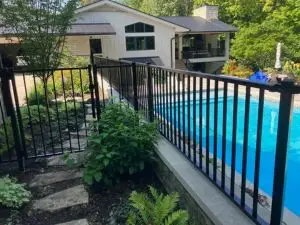
- Pool fencing is strictly regulated, most Ohio municipalities require a minimum 48-inch barrier with a self-closing, self-latching gate around any residential swimming pool
Before you start any fence project, call your local zoning office or check your city’s building department website. Taking 15 minutes to verify requirements can save you thousands in removal and installation costs.
HOA Fence Rules in Ohio: What You Need to Know
If your property is located within a homeowners association, the HOA’s covenants add another layer of rules on top of city codes and state law. HOAs in Ohio regularly regulate:
- Approved fence materials (wood, vinyl, aluminium; chain link is often prohibited)
- Specific colors or stain finishes
- Maximum height, sometimes more restrictive than city limits
- Placement relative to the front yard or street
Here’s the critical part many homeowners miss: HOA approval is a completely separate process from your city permit. You need both before starting work. Building a fence that complies with Columbus zoning but violates your HOA covenants can still result in fines or a legal order to remove the fence.
Always review your community’s governing documents and submit required applications before buying a single board.
What Happens If a Neighbour Builds a Fence on Your Property?
If a neighbour installs a fence that encroaches on your property, you have several options, and none of them require losing your temper.
Step 1: Get a survey. Commission a licensed surveyor to officially mark your property lines. This creates a documented record and is usually the foundation for any next steps.
Step 2: Talk directly. Once you have survey results, approach your neighbour calmly with documentation. Many fence disputes are resolved at this stage; sometimes the encroachment was genuinely accidental.
Step 3: File a complaint. For rural properties covered by ORC Chapter 971, a complaint can be filed with the board of township trustees, who serve as fence viewers and can assign responsibilities and mediate disputes without litigation.
Step 4: Legal action. If informal resolution fails, you can pursue the matter in the Ohio court of common pleas. An experienced real estate attorney can help you evaluate options. Don’t let a dispute drag on the longer an encroachment continues unchallenged, the more complicated your legal position can become.
Barbed Wire, Electric, and Other Restricted Fence Types
Not all fence materials are legal for residential use in Ohio. Common restrictions include:
- Barbed wire is typically prohibited in residential zones across Ohio municipalities. It may be permitted in rural agricultural areas under ORC Chapter 971, or with written agreement between adjoining rural landowners.
- Electric fences are generally restricted or outright prohibited in residential areas. In rural settings, they are permitted under specific conditions.
- Spite fences, fences built purely to annoy or harm a neighbour, occupy a legal grey area in Ohio. While courts may apply nuisance principles in extreme cases, a fence that meets height and setback rules is generally not actionable on spite grounds alone under Ohio case law.
Quick Reference: Ohio Fence Rules by Situation
| Situation | Key Rule |
| Front yard fence height | Generally 4 ft max; verify locally |
| Backyard fence height | Generally 6 ft without a permit |
| Shared rural fence cost | Split equitably if fence previously existed |
| No prior fence exists | Requesting owner pays full cost |
| Permit required? | Typically for fences over 6 ft or in front yards |
| HOA community | Separate HOA approval required on top of city permit |
| Pool fencing | 48-inch minimum barrier with self-latching gate |
| Barbed/electric wire | Generally prohibited in residential zones |
Ohio’s fence laws aren’t designed to make your life difficult; they’re built to protect your property rights and your neighbours’. The most common and costly mistakes come from skipping the research stage: not checking local ordinances, not getting a property survey, or not reading HOA documents before installation.
When in doubt, consulting a licensed Ohio fence contractor who understands local codes and permit requirements is one of the best investments you can make before a single post hits the ground.
FAQ
What is the fence law in Ohio?
In Ohio, fence laws usually depend on local city or county rules. Property owners should install fences within their property lines and follow height, material, and zoning regulations before building.
Can my neighbour build a fence on the property line in Ohio?
Yes, a neighbour can build a fence near a property line, but it generally should not cross onto your property without permission. In some cases, shared boundary fence rules may apply.
How tall can a fence be in Ohio?
Fence height limits in Ohio vary by city and zoning laws. In many residential areas, backyard fences are commonly allowed up to 6 feet, while front yard fences may have stricter height restrictions.