HOA-Compliant Residential Fencing in Ohio
If you live in an HOA community, the fence you want and the fence you’re allowed to build are two different conversations. The first is about your yard. The second is about a stack of covenants, an architectural review committee, and a deadline you didn’t know existed.
Scheiderer Fence installs HOA-compliant fencing for Ohio homeowners. We read your community’s guidelines before we recommend a single material, help you put together what the review committee wants to see, and then build exactly what was approved. The goal is simple: no violation letters, no fines, and no tearing out a fence you just paid for. Call 937-243-9991 for a free on-site estimate.
Why HOA Fences Get Rejected or Get Flagged After the Fact
 Most HOA problems come from the same few mistakes, and nearly all of them are avoidable:
- The fence was chosen before the covenants were read: A homeowner falls in love with a style and finds out later it’s not on the approved list.
- The approval was incomplete: Missing a drawing, a color, or a gate detail can send an application back and add weeks.
- The finished fence didn’t match what was approved: A slightly different stain, a few inches of extra height, or a different post cap is enough to trigger a violation.
- City approval was treated as HOA approval: They are two separate approvals, and having one doesn’t give you the other. Our Ohio fence permit guide explains how the city side works.
A fence that gets built wrong in an HOA is expensive to fix because the committee can require removal, not just adjustment.
What Review Committees Typically Look At
Every community has its own guidelines, but applications tend to come down to a handful of items. It helps to know them before you start:
- Approved Materials: Many communities specify which fencing materials are allowed. Wood, aluminum, and vinyl are commonly accepted, while chain-link and certain other materials may be restricted or prohibited.
- Fence Style and Openness: Some neighborhoods require open-style fencing in front yards or on lots bordering shared spaces, such as ponds, parks, or walking paths.
- Fence Height: HOA height limits are often stricter than city regulations and may vary for front, side, and rear yards.
- Color and Finish: Approved fence colors, stains, and finishes may be specified, sometimes down to particular shades.
- Fence Placement: Requirements may specify the distance between fences and property lines, easements, sidewalks, or neighboring homes.
- Finished Side: HOAs may require the finished or more attractive side of the fence to face outward toward the street or neighboring properties.
- Gates and Hardware: Guidelines may cover gate size, style, placement, and even hardware color.
If you want to see how HOA rules sit alongside the legal side of fencing in Ohio, our guide to Ohio fence laws lays it out.
How We Handle an HOA Fence Project
- Get your governing documents: Before the estimate, we ask for your fence guidelines or covenants, and any approved-materials list or architectural request form.
- Walk the property: We check your lot for things that affect approval, like easements, grade changes, and common-area boundaries.
- Recommend a fence that fits both your yard and the rules: We narrow the options to materials, styles, heights, and colors your HOA allows.
- Prepare what the committee needs: We give you a clear project description to attach, including the style, height, material, color, gate details, and fence layout on your lot. The application itself is typically submitted by the homeowner, since the HOA works with the property owner.
- Wait for approval before ordering: We don’t start work or buy materials until you have the HOA’s written approval in hand.
- Build exactly what was approved: Every detail is installed to match the approved plan, from post caps to color.
- Final walkthrough: We check the finished fence against the approved plan with you.
HOA review commonly takes two to four weeks, and sometimes longer for communities that only meet monthly. Starting early is the easiest way to protect your build date.
Fence Styles That Commonly Work in HOA Communities
Every community is different, so always confirm against your own guidelines. In general, these are the options that most often clear review:
- Black or bronze aluminum: Often accepted for front, side, and backyard fences, especially around ponds and common areas, because it keeps views open.
- White or neutral vinyl: Easy to match across a neighborhood and low on maintenance. If your community accepts it, neutral tones tend to review smoothly.
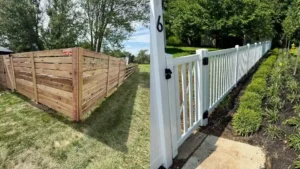
- Cedar or natural-stained wood: Common for backyard privacy, usually with limits on height, stain color, and which side faces out.
- Picket-style fencing: A natural fit for front yards and walkways where an open look is required. See our page on decorative and picket fencing for style options.
Need privacy but your HOA wants an open look in the front? Many homeowners use an open style in front and a taller privacy fence only in the rear yard, as long as the guidelines allow it.
Where HOA Approvals Often Stall
These are the details that most often hold up an application, even when the fence itself is allowed:
- No drawing of the fence layout: Committees want to see where the fence goes on your lot, not just a photo of a fence style.
- Vague color information: “White” or “brown” may not be enough. A manufacturer color name or stain sample gets approved faster.
- Easement conflicts: Fences across drainage or utility easements are a common reason for rejection.
- Common-area boundaries: Lots that back to green space or ponds often have the strictest requirements.
- Shared fence lines with neighbors: Some communities want neighbor acknowledgment before a fence on or near the line is approved. If you’re planning one, see our property boundary fencing
What If the HOA Says No?
A denial isn’t always the end of the project. Here is how we usually suggest handling it:
- Ask for the reason in writing: Knowing exactly what the objection is makes it easier to fix.
- Adjust the design: A different height, color, or material is often all it takes.
- Resubmit with the changes: We can update the project description to match the revised plan.
- Ask about a variance: If your lot has a real constraint, such as a slope or an unusual lot shape, some communities will consider an exception.
HOA decisions are always the association’s to make. We can’t guarantee an approval, but we can make sure your application is complete and your fence matches what you submit.
Already Built a Fence and Got a Violation Notice?
If you received a notice about an existing fence, send us the letter and your community’s guidelines. We can look at what doesn’t match, such as height, material, color, or placement, and tell you what it would take to bring the fence into compliance.
HOA Fencing Across Central Ohio
We work with homeowners in HOA communities throughout Delaware, Dublin, Marysville, and surrounding areas. Many of those neighborhoods also have city rules on top of HOA rules, so we review both before recommending a design. You can find the areas we serve on our locations page.
HOA-Compliant Fencing FAQs
Do I need HOA approval before installing a fence?
If you live in an HOA, almost always yes. Check your governing documents first, and get written approval before work starts.
Is HOA approval the same as a city fence permit?
No. They are separate approvals, and you may need both. A fence that meets city code can still violate your covenants.
Will Scheiderer Fence submit the HOA application for me?
The application is usually submitted by the homeowner. We prepare the project details, fence layout, and specifications you’ll need to attach, and we’re available to answer questions from the committee.
How long does HOA fence approval take?
Often two to four weeks, but it depends on how often your committee meets and how complete your application is.
What fence materials do HOAs usually allow?
That varies widely. Aluminum, wood, and vinyl are commonly accepted in some form, while chain link is often restricted. Your community’s guidelines are the final word.
Can I build a taller privacy fence in my backyard in an HOA?
Sometimes. Many HOAs cap rear-yard height or require certain styles, so check before you commit to a height.
What happens if I build without HOA approval?
The association can issue fines and may require you to remove or modify the fence. Getting approval first is far cheaper.
Get a Free HOA Fence Estimate
Tell us what your community requires and what you want your yard to look like, and we’ll find the fence that works for both. Call 937-243-9991 or request your free estimate.