If you own or manage a commercial property, you already know that security is not something you can afford to take lightly. Break-ins, vandalism, trespassing, and unauthorized access cost U.S. businesses billions of dollars every single year. The good news? One of the most reliable, cost-effective, and long-lasting solutions is sitting right at your property line, a well-chosen commercial security fence.
But here is where many business owners get it wrong: they pick a fence based on price alone, without understanding what each type actually offers in terms of strength, deterrence, and long-term value. The right commercial fence for business security depends on your property type, threat level, local zoning regulations, and even your brand image.
In this guide, I will walk you through every major commercial fence type, including the ones most ranking blogs overlook, so you can make a decision that actually protects your assets, your employees, and your bottom line.
Why Commercial Security Fencing Matters More Than You Think
A security camera records what happens after an intruder arrives. A well-installed commercial fence prevents them from arriving in the first place. That distinction is critical.
Research referenced by the National Institute of Justice found that most convicted burglars actively avoided properties that appeared difficult to breach. A properly specified commercial perimeter fence sends that message immediately, before any crime even begins. That is why many businesses invest in reliable security fencing solutions in Ohio to strengthen perimeter protection and deter unauthorized access before it becomes a problem.
Beyond crime deterrence, commercial security fencing also:
- Reduces liability by restricting unauthorized access to hazardous zones
- Supports your insurance risk profile, sometimes lowering premiums
- Helps meet local zoning and safety code requirements
- Defines property boundaries clearly to avoid disputes
- Adds measurable curb appeal and professional credibility
Now let us look at the actual fence types and what makes each one the right or wrong choice for your business.
Best Commercial Fence Types for Business Security (Detailed Breakdown)
1. Chain Link Fencing
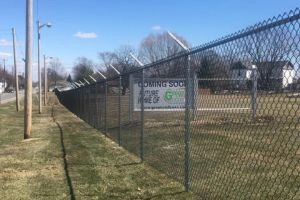
Chain link fencing is the most widely used commercial security fence type in the United States, and for good reason. Made from galvanized or vinyl-coated interwoven steel wire, it creates a strong perimeter barrier that is quick to install, easy to maintain, and highly cost-effective for covering large areas.
Best for: Warehouses, construction sites, industrial yards, schools, storage facilities, and parking lots.
Typical installed cost: $10 to $20 per linear foot (varies by height and gauge).
Security features to add: Barbed wire topper, razor wire coil, privacy slats, anti-climb extensions.
Key Advantages:
- Extremely cost-effective for large perimeters
- Allows full visibility; cameras and guards can monitor both sides easily
- Available in multiple heights (4 ft to 12 ft or more)
- Can be upgraded with barbed wire or razor wire for industrial security fencing
- Galvanized or PVC-coated finishes resist corrosion
One Important Consideration:
Standard chain link fencing is easier to climb than steel or wrought iron alternatives. For high-risk properties, pairing it with anti-climb topping (angled outward extensions or rotating spikes) and higher fence height (8 to 10 feet) significantly increases its deterrence factor. Always choose a heavier gauge wire, 9-gauge is standard, but 6-gauge provides considerably better resistance to cutting and tampering.
2. Welded Wire Mesh Fencing
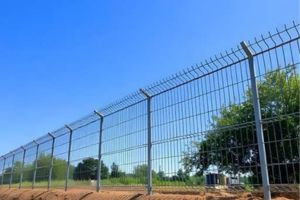
 Welded wire mesh, also known as welded wire panel fencing or rigid mesh fencing, is a step above chain link in terms of raw security. Instead of interwoven wire that can flex, welded mesh panels feature wires fused at every intersection point, creating a rigid structure that is extremely difficult to cut, bend, or pry apart.
Best for: data centres, government facilities, utilities, high-value inventory storage, correctional or detention-adjacent sites.
Typical installed cost: $20 to $40 per linear foot depending on gauge and panel configuration.
This is a preferred choice for anti-climb commercial fencing because the small aperture size (often 3 x 0.5 inches or smaller) leaves no foothold for climbing. The rigidity of the panels also means they resist cutting with standard tools, it takes significantly more time and effort to breach a welded mesh fence, which is itself a powerful deterrent.
Many high-security installations combine welded wire panels with a rolled razor wire topper and motion-sensing perimeter alarms to create a multi-layer commercial property security system.
3. Ornamental Steel Fencing
 For office complexes, medical facilities, gated business parks, and retail properties, ornamental steel fencing strikes the ideal balance between strong physical security and professional visual appeal. This is the type of commercial fence that says your business is protected without looking like a prison.
Best for: Corporate campuses, medical offices, upscale retail, hotels, apartment communities, and properties where brand image matters.
Typical installed cost: $25 to $50 per linear foot installed.
Ornamental steel features vertical pickets, often with spear or finial tops that discourage climbing connected by horizontal rails. The open picket design also provides unobstructed sightlines, making it ideal for CCTV integration and visual security monitoring.
Modern ornamental steel is powder-coated, which means it resists rust, corrosion, and UV damage for decades with minimal maintenance. If you are wondering what the best commercial fence for office parks looks like, ornamental steel is almost always the answer.
4. Aluminum Fencing
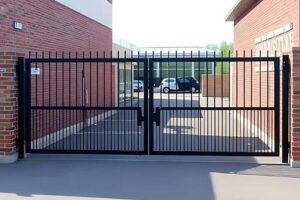 Aluminium fencing is ornamental steel’s lighter, corrosion-resistant cousin. Where steel offers superior raw strength, aluminium wins on longevity in harsh environments, particularly coastal regions, humid climates, and areas with heavy salt-air exposure.
Best for: Self-storage facilities, retail centers, distribution centers, schools, churches, coastal commercial properties.
Typical installed cost: $20 to $35 per linear foot.
Aluminum is naturally rust-proof and does not require the paint or sealant maintenance that steel demands. It can be anodized or powder-coated in a wide range of colors, making it easy to match your commercial property’s aesthetic. While it is not as impact-resistant as steel, properly installed commercial-grade aluminum fencing (as opposed to residential grade) provides solid perimeter security with decades of low-maintenance life.
5. Wrought Iron Fencing
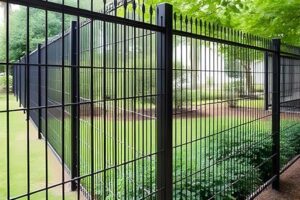 Wrought iron is one of the oldest fencing materials in existence and it remains relevant for commercial security because nothing beats its combination of raw toughness, visual authority, and lifespan. A properly maintained wrought iron fence can last 50 years or more.
Best for: Historic commercial properties, banks, government buildings, high-end hospitality, estates, and institutions where permanence signals stability.
Typical installed cost: $30 to $55 per linear foot.
Wrought iron’s vertical bars and decorative elements create a psychological as well as physical barrier. Intruders see it and understand immediately that breaching it will be difficult and noisy, a combination that deters most opportunistic criminals. The downside is that iron requires periodic painting or sealing to prevent rust. However, for businesses in lower-humidity inland areas, this maintenance burden is manageable and the long-term cost per year of service is actually quite competitive.
6. Anti-Climb and High-Security Steel Panel Fencing
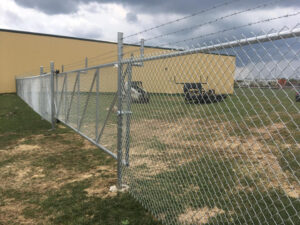 For the highest-risk commercial and industrial security fencing applications, utilities, data centres, government installations, defence contractors, and pharmaceutical storage, anti-climb fencing systems represent the top tier of perimeter protection.
These systems typically feature heavy-gauge welded steel panels with very narrow apertures (making it physically impossible to gain a foothold), combined with angled outward extensions, rotating spike collars, or palisade-style vertical steel bars with sharp pointed tops. Some installations also integrate electric fence elements or alarm-wired perimeter systems.
Best for: Critical infrastructure, high-value inventory facilities, properties at elevated security risk.
Typical installed cost: $60 and above per linear foot for top-tier anti-climb commercial security systems.
If you are protecting assets that cannot afford to be compromised, whether that means confidential data, controlled substances, or expensive equipment, this is the category of commercial fence worth the investment.
7. Vinyl Fencing
 Vinyl fencing occupies a unique position in the commercial security fence landscape. It is not the strongest choice for high-threat environments, but for businesses that need clean, durable property demarcation with solid privacy think retail parking lots, hospitality pools, dumpster enclosures, or daycare outdoor areas, vinyl performs well and requires almost no maintenance.
Best for: Retail and hospitality properties, childcare centers, pool enclosures, service area screening.
Typical installed cost: $15 to $30 per linear foot.
Vinyl does not rust, rot, or splinter, and it can last several decades with only occasional cleaning. Modern steel-reinforced vinyl rails hold up surprisingly well. Just keep in mind that vinyl is not recommended for high-security applications; it is too lightweight to meaningfully resist a determined intruder.
What Height Should a Commercial Security Fence Be?
This is one of the most common questions business owners ask, and the answer depends directly on your property’s risk level and local zoning codes.
- Standard commercial properties: Most local codes require 6 to 8 feet as a minimum for commercial fencing.
- High-security zones (industrial facilities, utilities, and government buildings): 10 feet or more, often with anti-climb topping, is the norm.
- Retail and office properties: 6 feet is generally sufficient when paired with proper gate hardware and CCTV.
Height alone is not enough. A 10-foot chain link fence with a flimsy gate latch is only as secure as its weakest point. Gate hardware self-closing hinges, magnetic latches, drop bars, and lockable systems must match the security specification of the fence itself.
Which Type of Commercial Fence Is Most Cost-Effective for Large Properties?
For large industrial or commercial perimeters, chain link fencing remains the most cost-effective commercial fencing solution. It can cover hundreds of linear feet at $10 to $20 per foot installed, far less than ornamental steel or welded mesh while still providing a meaningful physical and visual deterrent.
For businesses that need coverage over a large perimeter but also have a visible front entrance, a practical approach is to use chain link fencing for the back and side perimeters (where cost efficiency matters most) and upgrade to ornamental steel or aluminum at the entrance and street-facing sections (where professional appearance matters most). This hybrid commercial fencing strategy delivers the best security-to-cost ratio for most properties.
How Do I Choose the Right Commercial Fence for My Business Type?
Different business types have different fencing priorities. Here is a quick reference guide based on industry:
Warehouses and industrial facilities: Chain link with barbed wire, or welded wire mesh for higher-security perimeters. Focus on height and gate strength.
Office complexes and corporate campuses: Ornamental steel or aluminum. Prioritize professional appearance alongside security. Integrate with automated gate and access control systems.
Retail properties and shopping centers: Ornamental aluminum or vinyl for visible areas; chain link for back-of-property perimeters.
Schools and childcare facilities: Chain link or aluminum with controlled, monitored entry gates. Height and gate security are especially critical.
Data centers and high-security facilities: Welded wire mesh or anti-climb steel panel fencing with additional layered security measures.
Hospitality and hotel properties: ornamental aluminium or wrought iron. Security that enhances rather than detracts from curb appeal.
Do Not Forget: Access Control Is Part of Your Commercial Fence System
Even the strongest commercial fence is only as secure as its entry points. A properly installed commercial gate system especially one with automated access control, is not optional. It is the piece that completes the perimeter.
Modern commercial gate systems for business security include:
- Keypad or PIN entry gates for after-hours access control
- Card reader and proximity badge systems for employee entry management
- Biometric access systems for ultra-high-security applications
- Remote-operated sliding or swing gates for vehicle access control
- CCTV and intercom integration at gate entry points
The gate hardware itself, hinges, latches, and lock mechanisms must match the strength specification of the fence. As part of delivering expert fencing solutions for businesses, self-closing hinges, drop bars, and commercial-grade padlock compatibility are considered baseline requirements for any serious commercial security installation.
Expert Insight: What Experienced Security Professionals Actually Recommend
After years of working with commercial property managers, facility security directors, and fencing installation contractors, a few consistent truths emerge:
- Do not choose your commercial fence based on upfront cost alone. A cheaper fence that fails security inspection, requires frequent repairs, or does not meet local zoning codes will cost more in the long run than a correctly specified installation from day one.
- Gauge matters as much as material. For chain link, always specify heavy-gauge wire (6 or 9 gauge) for commercial applications. Residential-grade wire is cheaper but meaningfully weaker.
- The gate is your vulnerability. Most successful perimeter breaches happen at gate points, not through fence panels. Invest in gate hardware proportional to your fence quality.
- Pair your fence with technology. Motion-activated lighting, perimeter cameras, and alarm systems multiply the effectiveness of any fence type exponentially.
- Check local zoning codes before you buy. Commercial fence height limits, setback requirements, and material restrictions vary by municipality. Violations can result in removal orders.
Quick Comparison – Commercial Fence Types at a Glance
Chain Link: Cost: $10-$20/ft | Security Level: Medium | Best Use: Industrial, warehouses, large perimeters | Maintenance: Low
Welded Wire Mesh: Cost: $20-$40/ft | Security Level: High | Best Use: Data centers, high-value storage | Maintenance: Low
Ornamental Steel: Cost: $25-$50/ft | Security Level: High | Best Use: Offices, retail, campuses | Maintenance: Low-Medium
Aluminum: Cost: $20-$35/ft | Security Level: Medium-High | Best Use: Coastal/humid areas, retail | Maintenance: Very Low
Wrought Iron: Cost: $30-$55/ft | Security Level: Very High | Best Use: Banks, institutions, historic properties | Maintenance: Medium
Anti-Climb Steel Panels: Cost: $60+/ft | Security Level: Maximum | Best Use: Critical infrastructure | Maintenance: Low
Vinyl: Cost: $15-$30/ft | Security Level: Low-Medium | Best Use: Privacy screening, low-risk perimeters | Maintenance: Very Low
Frequently Asked Questions About Commercial Security Fencing
What is the most secure type of commercial fence?
Welded wire mesh panels and anti-climb steel panel fencing offer the highest security for commercial properties. For most standard businesses, heavy-gauge ornamental steel with proper gate hardware provides an excellent balance of security and professional appearance.
How tall should a commercial security fence be?
Most local zoning codes require 6 to 8 feet for standard commercial properties. High-risk facilities such as utilities, industrial sites, and government buildings typically require 10 feet or more, often with anti-climb topping. Always verify local regulations before installation.
Is chain link fencing good enough for business security?
Chain link fencing is effective for many commercial applications, especially warehouses, construction sites, and large industrial perimeters. For improved security, specify heavy-gauge wire, add barbed or razor wire topping, and pair it with strong gate hardware and CCTV coverage.
Final Thoughts: Making the Right Choice for Your Business
Choosing the best commercial fence type for your business security is ultimately about matching the right solution to your specific situation. There is no single fence that is right for every property, and any guide that tells you otherwise is oversimplifying.
If you manage a warehouse or industrial facility, chain link fencing with heavy-gauge wire and barbed wire topping is often the most practical and cost-effective solution. If you operate a professional services firm or upscale retail business, ornamental steel or aluminum fencing typically provides better long-term value. For properties housing high-value assets or critical infrastructure, welded mesh or anti-climb panels are often the preferred choice for enhanced security.
Whatever material you choose, remember: height, gate hardware, and integration with your broader security systems (cameras, lighting, access control) determine whether your commercial fence actually works or just looks like it does.
Get the specification right from the start, work with a qualified commercial fencing contractor who understands both security requirements and local code compliance, and your fence will pay for itself many times over in the years ahead.