You just finished staining your fence, and now there’s a dark cloud on the horizon. Is it too late to save the finish, or do you have a window?
Most wood stains need at least 24 hours of dry weather before they can handle rain. Water-based stains can be rain-ready in as little as 4 to 6 hours, while oil-based stains typically need 24 to 48 hours. “Dry to the touch” isn’t the same as “rain safe” . Always check your product’s label for its specific rain-ready time.
At Scheiderer Fencing, we’ve walked property lines in Marysville and across Central Ohio for years, and one of the most common calls we get isn’t about a fence that failed, it’s about a stain job that got caught by weather it wasn’t given enough time to beat. A rushed stain before a storm almost always costs more time in the long run than waiting one more day would have. If you’re planning to stain a new wood fence installation or refresh an older one, here’s how to time it right.
How Long Does Stain Take to Dry?
Drying time depends on the stain type, the wood, and the weather that day, not just the number on the can. Here’s a general breakdown:
| Stain Type |
Dry to Touch |
Rain-Safe Window |
Full Cure |
| Water-based |
1–4 hours |
4–6 hours |
24–72 hours |
| Oil-based |
6–12 hours |
24–48 hours |
48–72 hours |
| Quick-dry / hybrid formulas |
1–2 hours |
2–4 hours |
24–48 hours |
These are typical ranges, not guarantees that different brands within the same category can vary by several hours, so the label always wins.
How Long Does It Take for Deck Stain to Dry?
Deck boards lie flat, so rain pools on them instead of running off like it does on a vertical fence board. That means deck stain generally needs the longer end of the drying window, and you’ll want to wait even longer before furniture or foot traffic returns. If you’re staining a deck and a fence the same weekend, plan your timing around the deck, it’s the more weather-sensitive job of the two.
Oil-Based vs. Water-Based Stain Dry Time
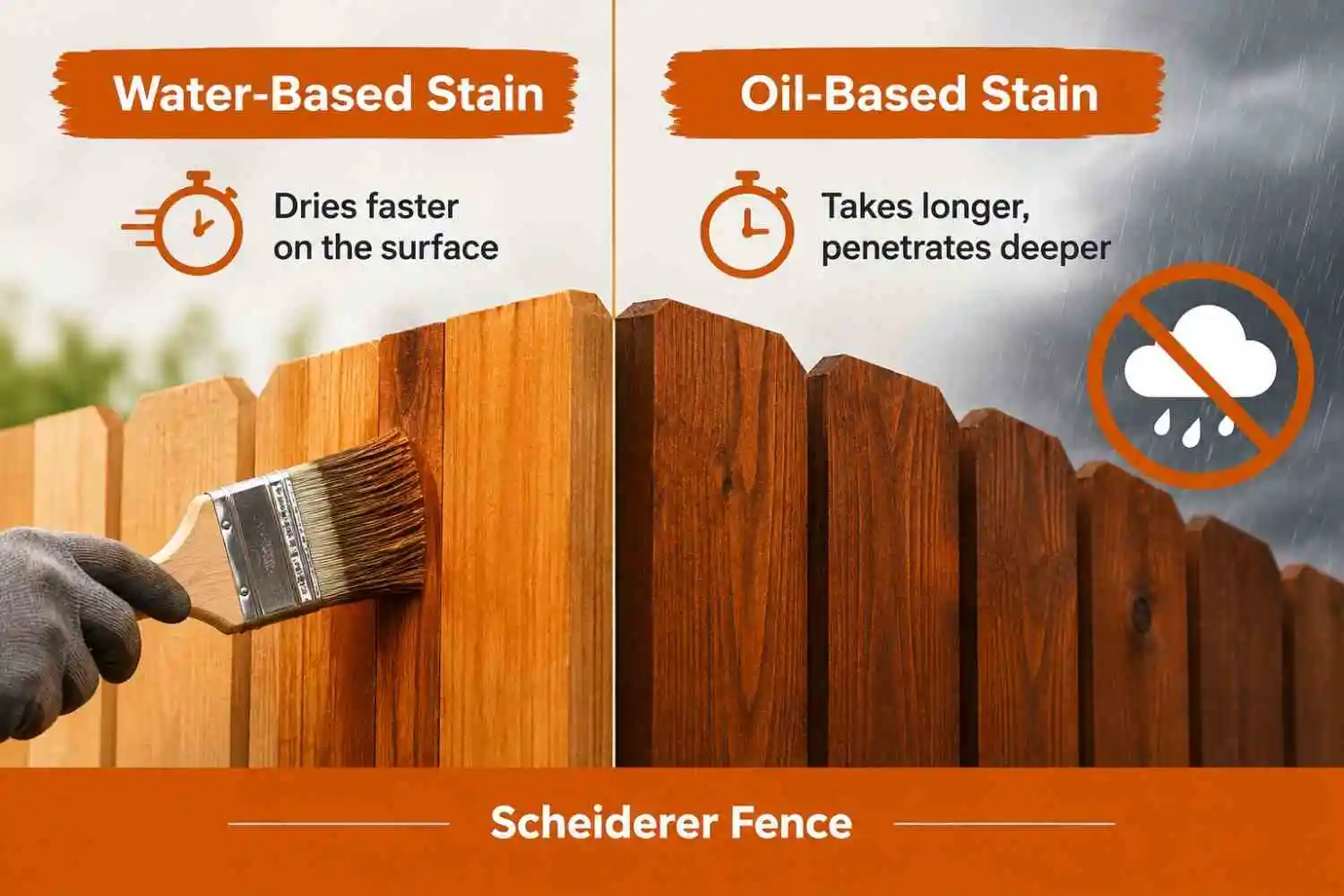
Water-based stain dries faster on the surface, which is why a lot of homeowners reach for it when the forecast is tight. But surface-dry doesn’t mean bonded rain within the first few hours can still cause spotting, even on a water-based finish. Oil-based stain takes longer up front, but it penetrates deeper into the wood grain, which is part of why many fence contractors still prefer it for long-term protection on cedar and pressure-treated boards. Neither one is rain-proof the moment it looks dry.
Best Weather for Staining a Fence
Stain dries fastest between 50°F and 85°F with low humidity. Below that range, drying slows down considerably. Above it, especially on a hot, sun-baked board, stains can dry too fast on the surface and trap moisture underneath, which causes its own set of problems.
Ohio’s mix of humid summer stretches and unpredictable fall rain means the safe window you get in July can look nothing like the one you get in October. The most reliable approach is to pick a stretch with at least 24 to 48 hours of dry, moderate weather, rather than staining the moment you get a free afternoon and to make sure the wood itself has dried out if it rained the day before. Our post on how weather affects fence lifespan covers how these seasonal swings wear on fencing over time, including why properly treated wood, the kind covered in our guide on whether pressure-treated fence panels are worth it holds up better against them to begin with.
How to Make Stain Dry Faster
You can’t safely force-cure stain, but you can stack the odds in your favor:
- Stain on a dry, mild day not right after rain, and not in direct midday heat
- Apply a thin, even coat instead of a heavy one; thick coats trap moisture and take much longer to dry
- Make sure the wood itself is fully dry before you start, not just the surface
- Choose a quick-dry or rain-resistant formula if your window is tight
- Give it airflow a shaded, sheltered fence line dries slower than one with a breeze
What Happens If It Rains on Wet Stain?
If rain hits before the stain is rain-safe, don’t grab a brush right away. Let the area dry out completely first, then take a look. You’re checking for water spots, streaking, a tacky or uneven finish, or patches that look washed out. Small, localized spotting sometimes just needs a light recoat once everything’s fully dry. Heavier or more uneven damage usually means sanding back the affected boards and retaining that section which is exactly the redo you’re trying to avoid by timing it right the first time.
We see this most often in early spring, when a warm afternoon tempts homeowners to get ahead of the season, and a system moves in faster than the forecast expected. It’s rarely the stain’s fault, it’s almost always the timing. If you’re staring at a patchy section and aren’t sure whether it needs a simple recoat or a full redo, it’s worth getting a second opinion before you start standing feel free to reach out to our team and we can help you figure out which one you’re actually dealing with.
Frequently Asked Questions
Q.1 How long does stain take to dry?
Most stains are dry to the touch within a few hours, but full curing and rain-readiness take longer anywhere from about 4 hours for water-based formulas up to 48 hours for oil-based ones.
Q.2 How to make stain dry faster?
Apply thin coats, stain on a mild dry day, confirm the wood is fully dry beforehand, and use a quick-dry formula if your weather window is short. Beyond that, you can’t safely rush curing.
Q.3 How long should stains cure before rain?
Plan for at least 24 hours of dry weather as a baseline, and closer to 48 hours for oil-based stains or humid conditions.
Q.4 How long does it take for deck stains to dry?
Deck stain generally needs more time than fence stain, since it sits flat and takes on standing water budget for the longer end of the drying range.
Q.5 Can it rain a few hours after staining?
Light rain within the first few hours can still cause spotting or streaking, even if the surface feels dry. Go by the product’s stated rain-ready time, not by touch alone.
Q.6 What happens if it rains on wet stains?
You may see water spots, streaking, or an uneven finish. Let the wood dry fully before inspecting, and never apply more stain over a surface that’s still damp.
Before You Stain Again
Timing a stain job around the weather is one of those small details that’s easy to overlook and costly to redo. If you’re staining new wood fence panels or refreshing an existing fence line, working with an experienced fence company that builds staining into the installation process from the start makes this kind of timing second nature.
Before you pick up a brush, it’s worth checking the local weather forecast and your product’s rain-ready window. That’s what separates a finish that lasts from one you’re patching by June.