
A 500-foot commercial fence typically takes 2 to 5 working days on site, once the ground is prepped and materials are staged. Chain-link on a clean, flat lot? You’re usually looking at closer to 2–3 days. A security perimeter with multiple vehicle gates, difficult soil, or utility conflicts? Plan for 4–5 days or more.
But if you’re managing an active facility in Ohio and trying to build a real project schedule around this, you need more than a range. Here’s what actually drives the timeline and where projects quietly lose days.
What “500 Feet of Fence” Actually Means on a Job Site
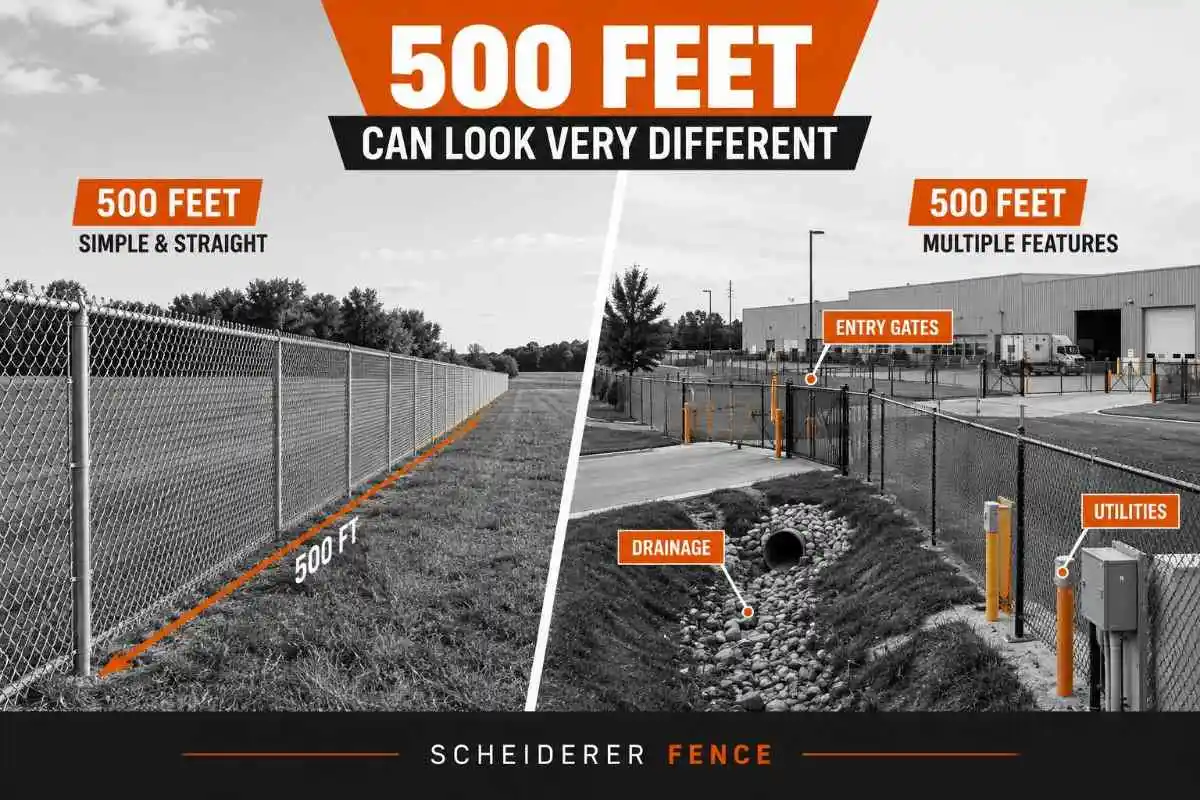
A straight 500-foot chain link run across open, flat ground is a fundamentally different job than 500 feet of fencing wrapping an active industrial property with three vehicle entry points, a drainage swale, and buried electrical running through the fence corridor.
In our 16+ years of commercial fencing services across Central Ohio, the most common scheduling mistake we see property managers make is planning around footage alone. The better variable to plan around is site complexity, and that only becomes clear after a contractor walks the property.
Realistic Installation Timelines by Fence Type
Here’s how typical 500-foot commercial installations break down by fence type and conditions:
| Fence Type & Site Condition | Approximate On-Site Time |
| Straightforward chain link, flat terrain | 2–3 working days |
| Chain link with 2–3 gates | 3–4 working days |
| Privacy or heavy commercial panel fence | 3–5 working days |
| High-security fencing with access control | 4–5+ working days |
| Difficult terrain, rock, or site prep required | 5+ working days |
These ranges assume materials are staged and the site is ready to dig. They do not include permitting, utility locating, or concrete cure time all of which can affect when the next phase of work starts.
How a Commercial Fence Crew Actually Works Through a 500-Foot Project
A professional commercial fencing crew doesn’t just show up and start driving posts. Here’s a realistic sequence for a standard chain link installation:
Day 1: Crew confirms layout and gate locations, locates underground utilities, marks post spacing, then begins drilling and setting posts. Concrete is poured the same day on most projects.
Day 2: Once posts are set and concrete has cured sufficiently, the crew installs rails and top rails, then stretches and fastens the chain link fabric across the run.
Day 3: Gates are installed; this is where most of the precision work happens. Alignment, swing clearance, hardware, and latch testing all require careful attention. Final tensioning, any tie wire work, and site cleanup round out the day.
That three-day sequence can compress or stretch depending on what’s below ground, how many gates are involved, and whether any post holes hit rock or old concrete.
The Factor Most Business Owners Don’t Account For: Gates
If there’s one variable that consistently adds time to a commercial fence project, it’s gates.
An uninterrupted fence line is repetitive work; once the crew finds its rhythm, footage moves fast. Gates break that rhythm. Each one requires heavier corner or end posts, a more precise layout, hardware installation, swing or slide clearance testing, and often a second look before it’s handed off.
A single pedestrian gate adds relatively little time. Two large vehicle gates with automated openers are a different story that work may also need to be coordinated with an electrician or gate-operator technician, which introduces scheduling dependencies outside the fence crew’s control.
Before your contractor confirms a completion date, make sure every gate location, type, and access requirement is on the table.
Site Conditions That Quietly Add Days
Beyond gate count, these are the conditions we most commonly see extend a commercial fence project timeline:
Hard or rocky soil. Post-hole drilling slows significantly when a crew hits clay, limestone shelf, or buried concrete from a prior structure. This isn’t predictable from a satellite view or a linear-foot estimate; it only shows up when the auger goes in the ground.
Utility conflicts. Every commercial dig requires utility locating before the first hole is drilled. If a buried line runs through the fence corridor, the layout may need to shift, or work may need to pause until a utility company can mark or reroute. This step isn’t optional, and it isn’t instant.
Site access. If materials and equipment can’t reach the fence line efficiently due to active loading docks, parked equipment, narrow access lanes, or operating-hours restrictions, daily output drops. Active businesses are harder to fence than empty lots, and that’s worth building into your schedule.
Weather. Frozen ground, heavy rain, and standing water after a storm all affect excavation, concrete placement, and site safety. A responsible contractor will give you a realistic window, not a guaranteed date, before setting foot on the property.
Total Project Timeline vs. On-Site Installation Time
Here’s the distinction that matters most for facility planning: installation time and total project timeline are not the same thing.
A commercial fence crew may be on your property for 3 days. But before that first post goes in the ground, you’ve likely been through:
- A site evaluation and layout confirmation
- Material selection and order lead time (custom components can add time)
- Permit applications, where required
- Utility locating (typically required 3 business days in advance in Ohio)
- Crew scheduling, which can vary by season and demand
For most straightforward projects, plan 2–4 weeks from first contact to installation start. For larger or more complex properties, or projects requiring permits, budget additional time on the front end.
If you’re comparing different systems for your facility, our guide to commercial fence types for business security breaks down what each option offers in terms of installation speed, durability, and access control compatibility.
How to Keep Your Commercial Fence Project on Schedule
You have more control over the timeline than most property managers realize. These steps consistently reduce delays:
- Layout changes after materials are ordered can push your start date and affect crew scheduling.
- Employees, delivery trucks, emergency vehicles, and customer entrances all have different requirements. Get them on paper before the site visit.
- Stored equipment, overgrown vegetation, or parked vehicles along the fence line slow the crew’s first-day productivity.
- If grading, paving, drainage work, or electrical is happening near the fence line, establish which phase comes first. Fence posts set before a paving contractor finishes can complicate both schedules.
- Don’t assume permitting is someone else’s problem until the crew is already scheduled. Local requirements vary across Ohio jurisdictions.
For a deeper look at what separates reliable fence crews from ones that create delays, our resource on how to choose a commercial fence contractor covers the questions worth asking before you sign anything.
Planning a Project That Includes Gates or Controlled Access?
If your 500-foot perimeter includes vehicle entries, pedestrian gates, or any form of automated or card-access control, that component deserves its own conversation with your contractor before installation starts. Our commercial gates and access solutions page outlines the options available for facilities that need security handoffs, controlled traffic flow, or integration with existing access systems.
For a full picture of what’s available for commercial and industrial properties, the full range of fencing solutions at Scheiderer Fence covers everything from heavy security perimeters to agricultural and specialty applications.
Frequently Asked Questions
Q.1 How long does it take to install a commercial fence?
Most commercial installations covering 500 feet take 2–5 working days on site, depending on fence type, gates, soil conditions, and site access. Chain link on open, flat ground typically runs 2–3 days. More complex systems run longer.
Q.2 How long does it take to install 500 ft of fence?
Under standard conditions with a professional crew, 500 feet of commercial chain link can be installed in approximately 2–3 working days. Security fencing, heavy panels, or difficult terrain can extend that to 4–5 days or more.
Q.3 How many days does it take to install a commercial security fence?
A commercial security perimeter, especially one with multiple gates, heavier post structures, or access-control integration typically takes 4–5 or more working days for 500 feet.
Q.4 What factors add the most time to a commercial fence installation?
Gates, difficult soil, underground utility conflicts, limited site access, weather delays, and last-minute layout changes are the most common causes of extended timelines.
Q.5 How long does commercial chain link fence installation take?
Chain link is one of the faster commercial systems to install. A 500-foot run under straightforward conditions can typically be completed in 2–3 days by an experienced crew.
Q.6 Does a longer fence always take proportionally more time?
Not necessarily. Once a crew is mobilized and the layout is set, longer straight runs can sometimes move faster per foot than shorter, more complex layouts. Gates, corners, and site conditions matter more than raw footage.
Ready to Plan Your 500-Foot Commercial Fence Installation?
At Scheiderer Fencing, we’ve been installing commercial, industrial, and security fencing across Marysville and Central Ohio for more than 16 years. Owner Caleb Scheiderer built this company around honest timelines, real site evaluations, and crews that take the finished product as seriously as the schedule.
We don’t quote timelines from a satellite view. We walk the property, evaluate your soil, locate your utilities, confirm your gate requirements, and then give you a realistic project window you can actually build around.