
If you’ve lived in Ohio for more than a couple of years, you already know the drill. A storm rolls in off Lake Erie, winds crank up to 60 mph, and the next morning you’re out back staring at your neighbor’s fence panel sitting in your yard or worse, what’s left of yours. It happens every season, from the spring derechos that tear through central Ohio to the bitter winter gusts that just won’t quit in the western flatlands.
Picking a fence isn’t just a curb appeal decision here. In Ohio, it’s practically a weather decision. The wrong fence in the wrong spot doesn’t just look bad after a storm; it becomes a liability, a repair bill, and a weekend project you didn’t plan for.
This guide breaks down the strongest, most wind-resistant fencing options available for Ohio homeowners and business owners, explains exactly why each one performs the way it does in high winds, and helps you figure out which type fits your specific situation.
Why Ohio’s Weather Makes Fence Selection So Critical
Ohio sits in a geographic sweet spot, but not in a good way when it comes to wind. The northern part of the state gets lake-effect weather systems that can generate sustained winds and sudden gusts. Central and southern Ohio aren’t spared either, regularly dealing with thunderstorm outflow winds, occasional tornadoes, and that relentless winter wind that makes every structure work harder than it should.
According to NOAA data, Ohio averages around 11–13 mph winds annually, but peak gusts during storm events frequently exceed 50–70 mph. That’s not a minor consideration; that’s a real engineering factor when it comes to fencing for extreme weather conditions.
The problem most homeowners run into is buying a fence designed for average conditions, not Ohio conditions. A standard 6-foot privacy fence with solid panels and minimal post depth? In a calm suburban backyard, it’s fine. In an exposed lot near Findlay or along a ridge in Holmes County? It’s a sail waiting to catch wind.
What Makes a Fence Wind-Resistant?
Before diving into materials and styles, it helps to understand why some fences fail in the wind and others don’t. There are three main factors:
- Wind Load Capacity: Every fence structure has a wind load tolerance, the amount of lateral wind force it can handle before bending, warping, or tipping. High wind fence design accounts for post spacing, panel rigidity, and the total surface area exposed to wind. The more solid the panel, the more force it catches.
- Air Permeability: This is the big one that surprises most people. A fully solid fence catches 100% of the wind force. A fence with gaps or an open design lets wind pass through, dramatically reducing the load on the posts and rails. It sounds counterintuitive that a “less complete” fence being stronger, but it’s physics, and it’s why open-style fencing survives storms that destroy solid privacy panels.
- Post Depth and Concrete Footings: The most overlooked part of wind resistance is underground. A post set only 18 inches deep with minimal concrete will lever right out of the ground when wind torque builds. In Ohio’s freeze-thaw climate, shallow footings also heave over time. Proper installation calls for posts set below the frost line, typically 36–42 inches deep in most Ohio counties with adequate concrete diameter.
Keep these three factors in mind as we go through each fence type. They explain everything.
The Best Fence Types for Windy Areas in Ohio
1. Aluminum Fence: The Top Pick for Most Ohio Properties
If there’s one fence type that consistently outperforms in Ohio’s wind conditions, it’s aluminum. Here’s why it works so well: aluminum fencing is inherently open-style. The pickets are spaced, so wind passes through rather than slamming into a solid surface. There’s no “sail effect.”
Beyond airflow, aluminum is non-corrosive, which matters in Ohio, where freeze-thaw cycles and road salt exposure (especially in northern counties) degrade other materials quickly. A quality aluminum fence doesn’t rust, warp, or absorb moisture, all things that weaken structural integrity over time.
For residential use, aluminum ornamental fencing gives you clean aesthetics without sacrificing durability. For commercial properties, heavier-gauge aluminum with reinforced posts handles serious wind load without issue. This is a genuinely strong fence for strong winds, not just a marketing claim.
Best for: Homeowners wanting low-maintenance, long-term wind resistance; commercial properties needing professional appearance with durability.
Weakness: Not a privacy fence. If you need a visual barrier, this isn’t the right category.
2. Chain-Link Fence: The Most Underrated Windproof Option
Chain-link gets dismissed as industrial or unattractive, but from a pure wind-resistance standpoint, it’s one of the best performers available. The interlocking wire mesh is highly permeable, and wind moves through it with almost no resistance. Posts anchored correctly in concrete footings can handle extreme weather conditions that would flatten a wood privacy fence.
For commercial properties, industrial sites, farms, and larger residential lots in Ohio, chain-link is often the most practical storm fencing choice. It’s also one of the most cost-effective options, which matters when you’re fencing a large perimeter.
The knock against chain-link is appearance. That said, vinyl-coated versions have improved significantly, and privacy slats can be added, though adding slats does reduce wind permeability, so it’s a tradeoff worth understanding before you go that route.
Best for: Farms, commercial properties, large lots, and anywhere function outweighs aesthetics.
Weakness: Limited curb appeal; privacy slats reduce wind resistance.
3. Vinyl (PVC) Privacy Fence: Proceed With Caution in Exposed Areas
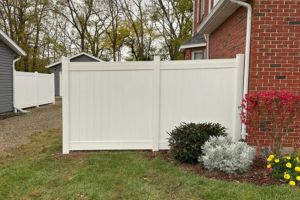
Vinyl fencing is popular in Ohio because it looks clean, requires minimal maintenance, and comes in a range of styles. But here’s the truth: solid vinyl privacy panels are one of the worst performers in high-wind situations.
The solid panel design creates maximum wind resistance. In a protected backyard with surrounding trees and structures, vinyl can hold up fine. But in an exposed location, an open lot, a property on a ridge, a new subdivision without mature landscaping, that solid panel becomes a problem in a serious storm.
That said, vinyl can work in windy areas if you choose a semi-privacy or shadowbox style (alternating boards that allow some airflow), use heavy-duty posts with proper depth, and reduce post spacing from the standard 8 feet to 6 feet for additional support.
Best for: Protected suburban backyards where privacy is the priority and wind exposure is moderate.
Weakness: Poor performance in open, exposed areas; solid panels catch the full wind force.
4. Wood Fence: The Variable Option
Wood fencing gives you the most design flexibility, but wind performance varies enormously depending on style. Here’s the breakdown:
- Solid privacy (dog-eared or flat-top panels): High wind risk. Full surface area catches wind. Only suitable in sheltered locations.
- Shadowbox / board-on-board: Better. The staggered boards allow some airflow through the gaps. A significant upgrade over solid panels.
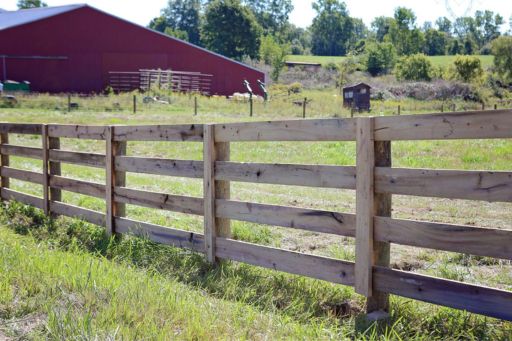
- Split rail or post-and-board: Excellent wind resistance. Very open design, minimal wind load. Popular on rural Ohio properties.
- Picket fence: Good wind performance due to spacing between pickets. Classic look with practical benefits.
Wood also requires more ongoing maintenance in Ohio’s climate, sealing, staining, and checking for rot. If you go with wood in a windy area, shadowbox or picket styles are the right choices. Solid panels are a gamble.
Best for: Rural properties (split rail), suburban homes wanting a traditional aesthetic (picket or shadowbox).
Weakness: Maintenance-heavy; solid styles fail in high winds.
5. Steel and Wrought Iron Fence: Heavy-Duty Wind Resistance
For properties needing serious structural integrity, steel and wrought iron fencing delivers. These are heavy, rigid, and open-style by nature, similar to aluminum in wind performance, but with considerably more weight and structural mass.
The downside is cost and maintenance. Steel and wrought iron require rust-prevention treatment and periodic repainting, which is a real consideration in Ohio’s wet climate. Powder-coated versions mitigate this, but they’re a premium product.
For commercial properties, high-security applications, or homeowners who want a permanent, high-end fence that will genuinely outlast the structure it surrounds, steel and iron make sense. The investment is front-loaded, but long-term costs are low.
Best for: Commercial properties, high-security perimeters, upscale residential applications.
Weakness: Higher upfront cost; some maintenance required to prevent corrosion.
Head-to-Head Comparison: Wind-Resistant Fence Options for Ohio
|
Fence Type |
Wind Resistance (Rating) | Privacy | Maintenance |
Best Use |
|
Aluminum (open) |
5/5 | Low | Very Low | Residential & commercial |
|
Chain-Link |
5/5 | Low | Very Low | Commercial, farms, large lots |
|
Vinyl (shadowbox) |
4/5 | Medium | Low | Protected suburban yards |
|
Wood (shadowbox) |
4/5 | Medium | Medium |
Residential, traditional look |
| Wood (solid privacy) | 2/5 | High | Medium |
Sheltered areas only |
| Vinyl (solid privacy) | 2/5 | High | Low |
Sheltered areas only |
| Steel / Wrought Iron | 5/5 | Low | Medium |
Commercial, premium residential |
High Wind Fence Design: What Good Installation Looks Like
Even the best fence material fails if it’s installed poorly. In windy areas of Ohio, these installation standards matter:
Post Depth: Set below the frost line, 36 to 42 inches in most Ohio locations. This prevents frost heave and provides the leverage resistance you need when 60 mph gusts hit.
Concrete Footings: Each post should be set in concrete, not just compacted soil. A diameter of at least 10–12 inches for standard residential fencing; wider for commercial or taller installations.
Reduced Post Spacing: Standard is 8 feet on center. In exposed, windy areas, drop that to 6 feet. It adds cost but dramatically increases wind load capacity.
Rail Connections: Mortise-and-tenon joints or through-bolted rail connections outperform simple rail brackets in high-wind conditions. Ask about the connection method before installation.
Panel Direction: In exposed locations, orient fence panels so wind hits the narrowest edge rather than the broad face where possible.
These aren’t upsell items; they’re the difference between a fence that survives Ohio winters and one that you’re calling to replace every couple of years.
Ohio-Specific Considerations You Should Know
Northern Ohio (Lake Erie Corridor): Wind exposure here is among the highest in the state. Aluminum or chain-link with proper footings is the safest choice. Avoid solid vinyl or wood in open lakefront or near-lake properties.
Central Ohio (Columbus Metro and Surrounds): New developments often have minimal windbreaks, no mature trees, and no neighboring structures. Shadowbox wood or vinyl in a protected yard is workable; open lots need open-style fencing.
Western Ohio (Flatlands, Findlay, Lima, Defiance): Flat terrain means wind has a long run-up with nothing to slow it down. This region sees some of the state’s worst storm damage to fencing. Aluminum and chain-link perform best here.
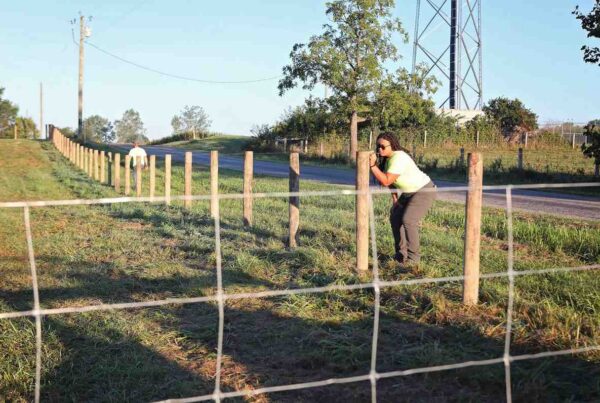
Rural and Agricultural Ohio: Split-rail wood, agricultural wire, or chain-link are the practical choices. Open design, simple construction, durable over large perimeters.
When Scheiderer Fence works with property owners across these regions, the conversation almost always starts with location and exposure before it gets to style. Where your property sits in Ohio determines more about your fence options than almost any other factor.
Which Option Is Right for You?
You need privacy AND wind resistance: Go with a shadowbox vinyl or wood fence, reduce post spacing to 6 feet, and make sure the property has some natural windbreak (existing trees, neighboring structures). A fully exposed lot is not the right place for a solid privacy fence, full stop.
You have a large open lot or farm: Chain-link with properly set posts is your best bet. Cost-effective, extremely wind-resistant, and low maintenance.
You want low maintenance and good appearance for a residential property: Aluminum ornamental is the answer. It handles Ohio’s weather conditions better than almost anything else in its category and looks sharp for decades with almost no upkeep.
You run a commercial property and need perimeter security: Steel, heavy-gauge aluminum, or chain-link with reinforced posts. Get a commercial-grade installation with a structural assessment for wind load.
You want a traditional wood look and don’t want solid privacy panels: Board-on-board (shadowbox) or picket style, properly installed with adequate post depth. Have it treated and sealed before the first Ohio winter.
You’re replacing a fence that blew down: Don’t just replace like-for-like. If a solid panel fence failed, installing the same thing again produces the same result. That’s the moment to reconsider the style.
Frequently Asked Questions About Wind-Resistant Fencing in Ohio
Q: What is the best fence for high winds in Ohio?
Aluminum ornamental fencing is the top choice; its open picket design lets wind pass through instead of building pressure against a solid surface. Installed with posts set 36–42 inches deep in concrete, it handles Ohio’s storms reliably. Chain-link is a strong second for larger lots and commercial properties.
Q: Will a privacy fence survive Ohio storms?
Solid wood or vinyl privacy panels are the most vulnerable in high winds; they catch the full force of every gust. If privacy matters, go with a shadowbox (board-on-board) style instead; the staggered boards allow airflow while still blocking the view. Tighten post spacing to 6 feet for extra stability in exposed areas.
Final Thoughts
Ohio’s weather doesn’t forgive the wrong fence choice, especially in exposed locations where wind has nothing to stop it. The rule is simple: open designs survive, solid panels struggle, and post depth matters as much as material.
When in doubt, talk to someone who knows Ohio conditions before you buy.
Ready to find what actually holds up on your property? The team at Scheiderer Fence has 20+ years installing wind-resistant fencing across Ohio. Reach out for a free consultation and stop replacing fences that shouldn’t have failed.